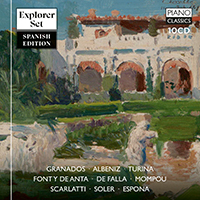
Antonio Soler, Domenico Scarlatti, Enrique Granados, Federico Mompou, Isaac Albéniz, Joaquin Turina, Manuel de Falla, Manuel Font y de Anta, Manuel Espona
Artist
Jean-François Dichamp, Esteban Sánchez, Sebastian Stanley, Pedro Piquero, Riccardo Schwartz, Benita Meshulam, Alessandro Deljavan, Melani Mestre pianos
Format
10 CD
Cat. number
PCL10363
EAN code
5063758103633
Release
February 2026
Share
Buy online
Download & streams
Other buying options
Buy in
Australia
Fish Fine Music Level 2, Shop 40-42 Queen Victoria Building Sydney CBD +61 (0)2 9264 6458 www.fishfinemusic.com.au
Thomas Music 31 Bourke Street Melbourne, Victoria, 3000 +61 (0)3 9650 9111 www.thomasmusic.net.au
A super-budget introduction to the riches of the Spanish piano repertoire, including many critically acclaimed recordings.
While Domenico Scarlatti was born in Naples, he spent the greater part of his career on the Iberian peninsula, and died in Madrid in 1757 as the composer of 555 keyboard sonatas which would, more than any other single body of work, bring Spanish idioms into the mainstream of European classical music. Many organists and keyboard composers preceded him, but few if any could match his spirit of caprice and restless invention as he fused Hispanic rhythms with the fairly new form of the keyboard sonata.
Thus it is fitting that Scarlatti is the earliest composer on this ‘Spanish Explorer’ box. His music was soon taken up as a model by native composers of subsequent generations, such as Manuel Espona (1714-1779) and Antonio Soler (1729-1783), in writing quirky single-movement sonatas of unpredictably arching melodies and sometimes frenetic developments which evoke the spirit of native dances such as the fandango.
While CD1 of this box is an imaginary ‘opera for piano’, staged by Jean-François Dichamp, the principle could be extended to the box as a whole. Dichamp’s opera is arranged around the pillars of the monumental cycle of Goyescas by Enrique Granados (1867-1916). This cycle, along with the Iberia of Isaac Albéniz (1860-1909), then extended the reach of Spanish piano music and defined its character in a late-Romantic world.
While neither Albeniz nor Granados were modernists by temperament, it is tempting to speculate how they and their music would have developed but for their early deaths in the first years of the last century. Instead the creative flame was passed to Manuel de Falla (1876-1946) and Joaquín Turina (1882-1949) and while de Falla’s original output for piano is relatively vestigial, it includes the astonishing Fantasia Baetica which invites comparison with contemporary piano masterpieces by Bartok and Prokofiev in its new pouring of ‘national’ character into the virtuoso piano tradition.
As the most recent composer in this Spanish Explorer box, Federico Mompou (1893-1987) is also the least definably ‘Spanish’ – not least because he was a Catalan born and bred. The music itself defies close analysis, much like that of his model Erik Satie, and yet its aura of intense contemplation has proved deeply rewarding for countless pianists and listeners alike.