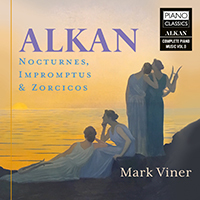
As they have been issued, each volume in this comprehensive survey of Alkan’s piano music has been eagerly awaited by the piano press and enthusiastically reviewed. In his playing, his research and his writing, Mark Viner has become the pre-eminent modern advocate of a composer still widely misunderstood and perennially under-rated. Volume 8 of the survey is organised according to Alkan’s treatment of three genre types: the nocturne, the impromptu and the zorcico.
The chaste dignity and cool classicism of the Nocturne Op.22 (published in 1844) ally it with the aesthetic of that father of the nocturne, John Field. Published in 1857, the two Nocturnes Op.57 explore far-flung keys, with the first of them cast in a dark and mystical mood, the second taking unusually rapid flight before a prayerful and dignified close. From 1859, the fourth and final nocturne evokes the chirping of a cricket.
Op.32 No.1 is a volume of four impromptus composed in the second half of the 1840s, each piece bearing an imaginative title: 'Charm' 'Friendship' 'Faith' and, in the 'Fantasietta alla moresca', a musical snapshot of North Africa. Op.32 No.2 is another set of four Impromptus, contemporary with the first volume. Continually experimenting with musical parameters, Alkan wrote the first three of the set in quintuple time (five beats to the bar) and the fourth in septuple, sometimes evoking the mystical world of Erik Satie, some decades in advance.
The Réconciliation, petit caprice Op.42 is another piece in a tripping quintuple metre, this time explicitly evoking a Basque dance known as the zorcico (zortziko). Meanwhile the history of the Zorcico, danse ibérienne (à 5 temps), bearing no opus number, is even more convoluted than usual, as Viner explains in his own extensive booklet notes: this is the first recording to represent Alkan's original manuscript.
The volume closes with a musical firework: Une fusée, introduction et impromptu Op. 55, careening across the keyboard with a toccata-like energy before exploding in a final blaze of D major. ‘If Alkan could play it as Viner does here,’ remarked Jeremy Nicholas of a piece in Volume 6 of this survey, ‘no wonder he was the only pianist in front of whom Liszt was hesitant of playing… Lovers of transcendent pianism (superbly recorded, by the way) and high-octane bravura need not hesitate.’